One model, that is an extension of the CLEM model that I applied to my practice in a previous post, is known as the SAMR model. It is a tool that educators can use to gauge how they are applying ICTs in their teaching and learning practices. Like Andrew, I have applied the model to my practice, particularly to gauge where I sit along the spectrum.
The following table provides a brief outline of the SAMR model.

In my practice I currently use a computer to design and create learning materials, some with a high level of detail, however, my students do not need to complete the activities using a computer, which they often bring with them to complete their assignments or any tasks/projects. I have used my computer to provide sessions on researching the web or how to use Endnote. In learning coaching, at this stage, ICTs are a tool that enables the effective design and completion of tasks but beyond that, I have not reached the modification or redefinition stage.
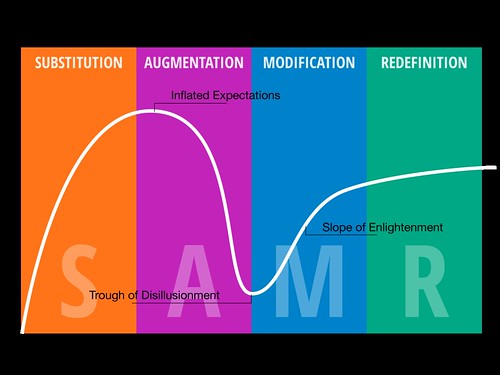
As the image above illustrates if a educator were to remain in the substitution phase, only using ICTs as a tool to do what is normally done, such as to create word documents, send emails or browse the Internet for information, then he or she would remain in the "trough of disillusionment," not experiencing the potential of the technology, both for themselves as well as their students. In the augmentation phase, although the technology may provide 'functional improvement,' such as using an iPhone to record notes, it would be again just using a new technology to complete an old process. Whereas, if one was to begin modifying their teaching through the use of ICTs - through redesigning what they do (i.e. creating photographic life stories that include audio and video) they would enter the "slope of enlightenment" - a stage of unprecedented learning and benefits for both the educator and learner. In the redesigning phase the educator has began using new technologies in unforeseen ways, where the photographic essay is displayed on their blog to share not only with their friends, family and peers/colleagues but also with the world at large.
Through applying the SAMR model I can see how it has potential to transform my practice. This is only the beginning but at least I have an idea of how it can change learning and teaching. I agree with Andrew that it is indeed a "powerful learning model."

No comments:
Post a Comment