Today's classroom


Yesteryear's classroom
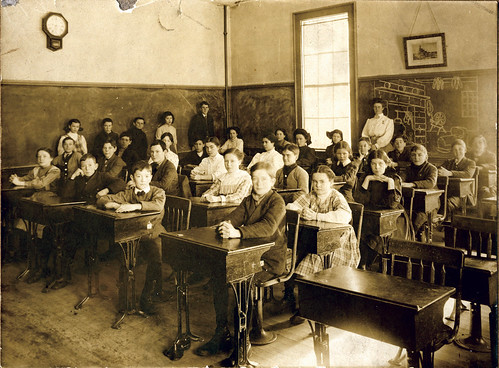
What causes this limited change? David, in his reflection on what perpetuates "existing institutional systems and processes," highlighted a presentation by Dave Snowden where he identifies the "memories of the past" as one of the major contributors to making things stay the same. When any type of systemic change begins to happen, as outlined by Siemens (2008), a dance of change happens in the process. For example, if something different is implemented, such as an innovative approach to learning (i.e. networked learning) there will be significant resistance (known as push-back factors) to the change (the catalyst), basically attempts to revert back to the way things were before (Siemens, 2008), and this can go back and throw for a long time. This is the reason why modern classrooms, despite all the technological advances, still remarkably resemble the early 19th century classroom, the "push-back" factors have been too great.
What I found most interesting is the idea that "our ability to learn, grow, and adapt to change pressures is directly related to the nature of our learning environments (Siemens, 2008). The mere structure of the classroom, with its associated behaviours and procedures, causes it to shape what is learnt, due to the "primacy of the educator," and to create passive learners, who are "receptive agents." As a "bounded space" the classroom framework confines learning to particular contexts, particularly to the "ecology" of the classroom. What is needed, as asserted by Siemens (2008), and I agree, is learning how to create and navigate through networks, as I am currently doing as a student, learner and teacher in NGL and in my role as a learning coach. This is a connectivist framework that prepares learners on how to navigate through the "distributed nature of knowledge and growing complexification of all aspects of society (Siemens, 2008)."
What intrigues me is how the system-wide thinking influences entrepreneurs or individuals who are operating outside of these systems. I agree that the existing classroom model is archaic and a problem for many learners. I have many students who come to me because of their disengagement or frustration with the activities or processes of the classroom, and this is at both the high school and university level. This is why I am seeing the importance of having learning coaches or advisers who accompany the learner on their learning journey, as guides, modelling skills along the way and providing encouragement too. As Seimens (2008) posits the question: "Do one-instructor classrooms need to give way to more diverse approaches of many instructors and many peer learners?" I think so.
Siemens (2008) proposes a "future model of learning that must embrace" in addition to formal education:
... learning [to] occur through games and simulations, mentoring and apprenticing, performance support at the point of a learning need, self-learning that arises through critical and creative thinking, communities of practice and personal learning networks, as well as the many informal learning situations that arise through conferences, reading, volunteering, and hobbies.As an educator I have learnt the truth of the notion by (Cannatella, 2007, p. 263 as cited in Siemens, 2008) that "[a]s we create space and place, we create ourselves." I have noticed this even in my studio, as a different environment can change not only how an individual perceives learning but also the opportunities that are available.
References:
Siemens, G. (2008). New structures and spaces of learning: The systemic impact of connective knowledge, connectivism, and networked learning. Retrieved from http://elearnspace.org/Articles/systemic_impact.htm

No comments:
Post a Comment