Saturday, 6 September 2014

How networks are changing Knowledge

Further to my discussion about networks and knowledge I have come to many realisations, particularly how I see formal and informal education, and how I see networked learning influencing what and how we learn.

Something that Iyanla Vanzant, an American speaker and author, said in an interview with Oprah (yes, I love Oprah, she's authentic in everything she does) really resonated with me and highlights my concerns with the decline of the Humanities in universities. Regardless of what one thinks of Iyanla's ideological position, she says that going to university teaches you "how to think, how to analyse ... and how to build an argument," something, in my opinion, that just navigating all the information on the web may not do.

Iyanla continues and says that she "did not go to law school to just to learn, she went to law school to train her mind." This is what drew me to Law when I first went to university in my mid-twenties. I withdrew after one year as the adversarial system was too confronting for my nature at that stage of my life (I was too young) and went into Education, nevertheless, what I learnt, and the structuring of ideas, particularly with the incorporation of sociology and history subjects, taught me how to really dig deep when learning and not to accept dominant paradigms. I really liked the questioning process and the relentless focus on coming to an informed position. Iyanla also says that at university "they don't care what you believe," you have to carefully layout your ideas and at the end demonstrate a very good understanding of the diversity of opinions but also your own. In other words, as I construe it, you come to an informed position.

A video called Networked Student provided me with an articulation of networked learning that allayed some of my concerns about what will happen to Knowledge. It outlines the exact process of learning that I, and my peers, are experiencing in NGL. Although from 2008 (and a little dated in a networked world) it explicitly outlines how, in contrast to my concern about learners not acquiring Knowledge, learners, in a Connectivist approach to how learning will look like in the future, or even what is beginning to happen right now, will be learning to come to an informed position. The video provides an example of how a student who is studying psychology (but it could be any field), is completing most of his learning online, with no textbook or lectures, a learning approach that emphasises the connections that are made rather than the tools that are used to learn. Through this social network approach, students are empowered to "take control of their learning and make new connections with others who will strengthen the learning process," as I am doing with fellow students in NGL. This can only be achieved by building a Personal Learning Network, via a PKM process, to be able to find valid information, keep track of that information and most importantly analyse that information. Through this Network the student is able to share his or her findings online with peers (through blogging) and through the sharing process come to an "informed point of view" about the topic or issue that is being learnt.

The Networked Student video, along with many others that illustrate the new world of networked learning all illustrate how, in contrast to the learning that prevailed in the university sector, that was largely modelled on the tree metaphor, a top-down approach to learning (i.e. major emphasis of the lecturer being the fountain of all knowledge and learning as more of an individual process) learning is now increasingly viewed as a networked metaphor, according to Steve Wheeler, a blogger on eLearning, where:
students seem to be digressing from prescribed pathways, but ultimately discover for themselves new, personalised pathways to explore, and serendipitously encounter pertinent content and experiences.  Students become the nodes of their own production, creating content and sharing it through social media tools, much the same way a gardener would cast seed on the ground.
This is particularly so when looking at contemporary learning theories such as Situated Learning Theory, that emphasise the collaborative but personalised nature of learning and the importance of learning in authentic contexts, through the use of cognitive tools in an "authentic domain activity." In other words, we can now directly apply what we are learning to our contexts, such as I am in my role as a learning coach and as a learner in NGL.

The video also illustrates how the role of the educator, as I have outlined in a previous post, has changed from knowledge provider to skill provider. The teacher models how to build one's network, take advantage of opportunities, provide guidance in resource acquisition and model how to communicate properly (one of my primary roles), particularly in how to engage in professional discourse in order to acquire what one needs or wants, critical analysis and evaluation (another one of my primary roles and major interests) and lastly, but not least, provide encouragement along the way. I see these as the educator's role as in the end these approaches to learning encourage learner autonomy and empowerment, the fundamental aim of education.

The structuring of learning modelled by the teacher brings to mind George Siemen's argument that there needs to be some structure to the learning process, described as "augmented systems of control," otherwise, he says, we may "descend into anarchy." Dave Snowden, however, says because the Internet has "human sense networks" that rely on a "lack of constraints," or are "chaotic," defined by Snowden to have an absence of constraints rather than merely randomness, only in this way can individuals and groups achieve "complete novelty." Nevertheless, Snowden, like Siemen's says that:
"It is important to have some type of constraint as without it you have randomness. There has to be a happy medium between the level of constraint, the level of flexibility against the level of uncertainty."
A recent example about the importance of have a structured sequence of learning, even if it is just in the form of teachers as guides/advisors, may illustrate my point. My son, a frequenter of Reddit, a social networking and news site, remarked about a social-psychological issue that effects men. I cannot give the particulars as it may not be appropriate but what the conversation illustrated to me, and to my younger son (who was present during the conversation and quoted the adage that "on the Internet nobody knows your a dog"), is the importance of critical analysis, something that I gained through university subjects (i.e. linguistics, history, sociology, etc.) that encouraged me to delve in the history of ideas and the representations of truth. At the end, I established, that if one was to only learn what they felt that they needed to, would they ever venture into areas that will challenge or at least disrupt their preconceived paradigms. The conversation ended with my eldest son (18 years) declaring that "not everyone is like you Mum. They may not care about whether they are coming from an informed understanding." We both laughed as it may just be a particularism of how I construe the world.

Although a long blog post I feel that not only am I gaining a deeper understanding about how Knowledge will be constructed in a networked world, I am also experiencing the learning benefits of blogging, as expressed by both Mari and Brendon, two bloggers in my network.
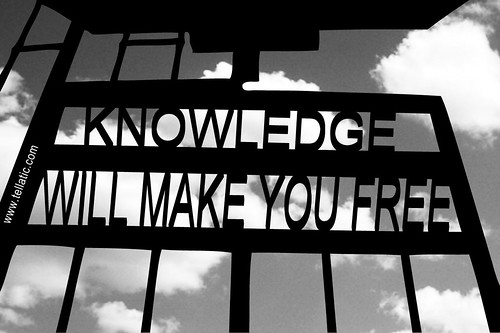
Knowledge will make you free by tellatic, on Flickr
Creative Commons Creative Commons Attribution 2.0 Generic License   by  tellatic 

Friday, 5 September 2014

Rethinking Knowledge in a networked world

One of my conundrums, as I have highlighted in previous posts, has been what will happen to Knowledge. I have used knowledge with a capital "K" because, as Weinberger, in his Too Big to Know: Rethinking Knowledge Now That the Facts Aren't the Facts, Experts are Everywhere, and the Smartest person in the Room Is the Room, outlines it has become an abstract noun that is treasured within Western society. At this stage I am halfway through the book and am intrigued by many of the ideas, jotting things down as I go along.

I have been also reading some of the reviews on Amazon to see what others think of Weinberger's ideas and have found, as with any piece of literature, a wide variety of viewpoints, to the extent that some are pummelling it as "the solution to the information overload problem" but others are claiming its arguments are "unconvincing."

In the former review Getaneh Agegn Alemu, a librarian, who is at the heart of the cataloguing and classification system of information, argues that the book by Weinberger is "disruptive" to classification systems but also to the "very definition of metadata," a modern term for cataloguing and classifying information. He or she writes that the book provides a critique of the classical DIKW (Data-Information-Knowledge-Wisdom) pyramid that has been the dominant model in computer science and library information. The writer also points out that the era of networks is better suited to how we as human beings make links. We don't do it in the "simplistic, linear and long form" way that information processing theories have posited but more like an "intricate web of links and associations." This is supported by Dave Snowden, a consultant in knowledge management, who says that the reason "why the web works" is because of the "small fragmented data items" that "associate and re-associate very quickly."
DIKW by AJC1, on Flickr
Creative Commons Creative Commons Attribution-Share Alike 2.0 Generic License   by  AJC1 

What is interesting is how the writer of the review highlights the phenonema of information overload has even made it into the DSM (Diagnostic and Statistical Manual) for psychiatrists. Even experiencing some angst or fatigue over too much information has become pathologised. I, like the writer of the review prefer Clay Shirky's arguments that it is "not information overload. It is filter failure." It is a skill that individuals need to learn rather than identifying it as a potential psychological issue that needs a label. There are also benefits of such an "open ecology," as Snowden also believes, where the environment of networked links will provide a "fertile ground for innovation and creativity."

In contrast to the above review Corwin J. Joy argues that the Weinberger's book provides an overly simplistic viewpoint on the benefits of networked thinking. He or she targets Weinberger's claim that when many experts are involved in a project or are solving a problem they develop the best answer rather than an individual on their own. Corwin writes how in the "real" world Weinberger's strategy will not work as a "network isn't going to magically come up with an answer." This is supported by an advertising guru John Hegarty, in his book There Are No Rules, who says that the thinking of groups only lead to "average," not innovation or creativity. I still have doubts about Weinberger's claim but in contrast to the group-thinking that happens in organisations, where, as Corwin asserts, "the same stupid wrong answers to a problem" is often circulated "around and around," the web lacks the structure and constraints, therefore, its chaotic structure, as Snowden conceptualises it, almost invites dissent in opinion, as there is no overarching authority to say who should say or do what - there may even be a "wisdom of crowds."

One of my concerns, as Corwin highlights, is that within the networked world there is not much of a role for "sustained" and "critical thinking," at least in as far as I have read so far. To make deep conceptual or paradigm shifts, as I have through deep study of theoretical ideas, particularly within fields like sociology, where the student is taken back to the Greek and Roman era of many millennia ago to the post-modern theorists of today, all the while questioning and re-evaluating everything they have ever known to be true or reality. Will students who are inundated with a plethora of information, provided by an endless array of networks, be able to engaged in the type of sustained thinking that is required for paradigm shifts. A friend of mine said that in the age of the Internet is it not that individuals have access to more ideas, what is happening is the same ideas are just going around and around.

These are my thoughts at this stage. It looks like I am not alone as I have been reading many of my peer's posts, such as Anne's, who is "not 100% sure" about the notion that teachers will become filters rather than sources of information, or knowledge. Nevertheless, she sees her primary role as providing her students with the "freedom and opportunity to construct their own knowledge." This reflects how Anne, and many teachers, in contrast to the past, see their role to nurture students who are active knowledge producers. Andrew has expressed similar concerns to me about what is happening to knowledge and whether the age of networks will be better or worse. Although many of us are embracing networked thinking we also question the process along the way.

Wednesday, 3 September 2014

Echo chambers in the web

The first time I experienced being in an "echo chamber," as it has been dubbed, was when I joined a forum in 2002. It was a "free thinking" type forum that questioned all dogma. I was in my twenties and was rebelling against what I perceived as the status quo. At first I thought, "This is great, like-minded people discussing similar ideas" but after a few months (it didn't take long), I noticed that the discussion began repeating itself and I perceived some individuals as too narrow minded and not at all the open-minded individuals that they espoused themselves to be. It also became a "choir preaching to itself" phenomena, where people with similar world-views get together, like each other's posts, and everyone ends up thinking the same thing. It certainly did not reflect the outside world and I got bored and left.

Science Museum by wetwebwork, on Flickr
Creative Commons Creative Commons Attribution 2.0 Generic License   by  wetwebwork 

It was a really good experience because it showed how when a "community" identify themselves as such, there is the inevitability of individuals seeing themselves as either the "insider" or the "other," and thus not engaging with other "outsiders" of the discourse. What I have found is that on the Internet, as in life, when you hang around only a type of people you risk being inward thinking. I realised that I did not want to go in that direction. Perhaps, as Paul highlights in his blog about "homophily," where some community members do not grow because they remain within the cultural group they were either born in or have adapted to, some individuals do it to have a sense of belonging. I saw this in the communities that I grew up in. I was a first-generation Australian but many of my extended family members or friends, many not born in Australia, remained in their cultural community, some not even learning English, although this was mostly due to the regions they came from and level of education.

I also saw the phenomena of homophilia in the workplace, where like-minded individuals built and sustained relationships, creating insiders and outsiders. This is one of my concerns about having schools operate like Charter schools in America, where the principal has the power to hire and fire. In my experience these groups can be mighty effective in enforcing who is in the "in" crowd and who belongs in the "out" crowd. However, this is certainly not isolated to just education and exists in all workplaces, therefore, Charter schools, particularly cyberschools, do have many things going for them, such as allowing some students to be taught over the Internet and engage in employment at the same time.

Andrew wrote a post about the negative aspects of NGL, such as the lack of access to technology for many students around Australia, and the difficulties some students may have with working online, particularly due to their unfamiliarity with technology or their preference to learn in other ways. These are definitely issues that I have seen first-hand. In previous posts I have also voiced my concern about what will happen to "knowledge" and the difficulties of not being able to interact in person (i.e. the social isolation). I have seen a lot of students prefer working online and some even appear to avoid interpersonal communication. However, even before the advent of computers there have been individuals who prefer one type of communication over another. I think computers have, for many, provided them with a voice that they did not have before. It is certainly a highly complex area that I wish to know more about.

Tuesday, 2 September 2014

What is happening to "knowledge"?

As I've highlighted in previous posts I've been thinking a lot about how knowledge is going to be thought about in a networked world. What is clear is that the conception of knowledge is changing but the question for me is where does this leave it?

I definitely have "pre-existing prejudices" about what is knowledge and how it should be acquired, as expressed in a previous post. In contrast to many of my students I grew up in the "library era." The Internet really came of age when I was in my early twenties. I discovered Google at about twenty-two years and have been using it as my major search engine ever since, trying out others along the way (i.e. Yahoo, Bing and other "imposters" along the way but finding Google's simple interface to be the best - there really is truth to the adage that "simple is often the best.") but being mostly content to use its interface. The likes of Google Scholar have been a bonus, and has added to its desirability and complexity.

Due to my insatiable desire to know what is happening to knowledge I decided to purchase Too Big to Know by David Weinberger through Audible (Audible is how I read a lot of my books, whilst driving, cleaning the house and even going for a walk. Why spend those moments in solitude I say). He presents an interesting argument about what it means to know something in a world where expert credentials or public acknowledgement of what you have achieved is not essential prerequisites for writing your own opinion on anything. I mean, I still look at an individual's "CV' when I begin reading their articles or what they have to say.

However, as I'm learning through Weinberger's book, and I'm only a quarter in at this stage, my preconception about what constitutes authority is due to my model of the world, in a bygone era where to say anything you had to be somebody that almost everyone agreed had the authority, at the very least, to speak about the topic. In other words, you needed legitimacy. According to my narrative of the world, an individual not only had to have a lot of knowledge about an area to write about it but they had to have lived and breathed it. Could explain why I purchased Weinberger's book, I saw him as having legitimacy to talk about it and my worshipping of the humble book.

Weinberger says it is too simple to assert that the Internet - due to the phantasmal amount of information that is accessible to anyone - will result in a "dumbed-down" population. He asserts, and with a very convincing argument, as supported by Cory, in his review of Weinberg's "book-length argument," that it is more important to see that the Internet is creating individuals who are able to better think for themselves, not just due to the endless variety of opinions that they have access to, but to the potential for participants to become active voices on the Internet, using the information to change the world. In other words, rather than be passive recipients, like in the bygone era where we passively acquired the information, either in school, the workplace or in front of the television or through reading the newspaper, we are now able to shape the information ourselves, thus feeling empowered through our contributions.

Advocates for the networked era that is the world we are in have many powerful arguments. In contrast to the "gilded cage" of the industrial age, in the information age information will be accessible to everyone. I for one am happy wit this. One of the things that really annoyed me once I graduated from university was not having access to the journals that I had come accustomed to for four years. I loved being on the "cutting-edge" of research, seeing what was the current thought patterns of leaders in the field. As soon as I left university I was shut out, no longer able to surf this vaulted networks, alas at a cost of almost $40 per journal. I was able to obtain memberships with teaching organisations but not to the calibre provided by universities.

Nevertheless, there are dangers. One the Internet, as I often tell my students, "nobody knows your dog." Although metaphorical it drives the point home, as it illustrates, regardless of how "nutty" or "wayward" your ideas, they can spread like wildfire. However, has this not always been the case, and is it more important to give these "alternative" voices a platform as what was once considered to be "radical" or even belonging to a "cult" can become the most liberating movement or even one of the world's major religions?

Know that I see I have access to leading academics in the field of networked learning, as David has illustrated through his blog, where he frequently shares with his audience, or whoever is interested in networked learning and its influence on higher education, can come and share in the discourse. A lot of other academics are following suit (i.e. Connected Courses), and I can imagine this will increase as the potential is realised. I'm already experiencing the fruition of being actively involved in networks, where individuals, such as Anne, share information on knowledge construction to assist in my understanding of the area.

Where does this leave me now? I'll continuing on my journey to find out what will happen to knowledge and share these ideas with you.

network by sjcockell, on Flickr
Creative Commons Creative Commons Attribution 2.0 Generic License   by  sjcockell 

Applying SAMR to learning coaching

Only in the last week or so have I began to actively share with my students, and even with family and friends, the tools that I have been using in NGL and all the ideas that I have been learning about. As my knowledge and use of the tools increased, and it started to feel like a part of my everyday process, I've began thinking about how NGL might transform the nature of my practice as a learning coach.

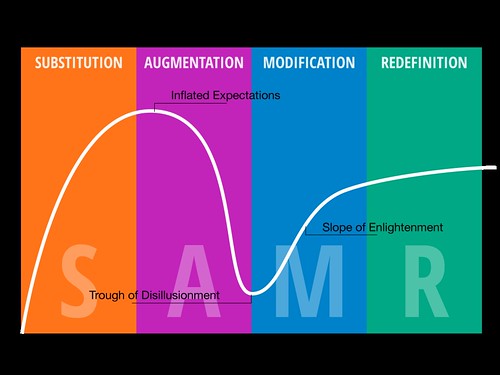
One model, that is an extension of the CLEM model that I applied to my practice in a previous post, is known as the SAMR model. It is a tool that educators can use to gauge how they are applying ICTs in their teaching and learning practices. Like Andrew, I have applied the model to my practice, particularly to gauge where I sit along the spectrum.

The following table provides a brief outline of the SAMR model.
SAMR + Hype Cycle - HiRes by tim.klapdor, on Flickr
Creative Commons Creative Commons Attribution-Share Alike 2.0 Generic License   by  tim.klapdor 

In my practice I currently use a computer to design and create learning materials, some with a high level of detail, however, my students do not need to complete the activities using a computer, which they often bring with them to complete their assignments or any tasks/projects. I have used my computer to provide sessions on researching the web or how to use Endnote. In learning coaching, at this stage, ICTs are a tool that enables the effective design and completion of tasks but beyond that, I have not reached the modification or redefinition stage.

As the image above illustrates if a educator were to remain in the substitution phase, only using ICTs as a tool to do what is normally done, such as to create word documents, send emails or browse the Internet for information, then he or she would remain in the "trough of disillusionment," not experiencing the potential of the technology, both for themselves as well as their students. In the augmentation phase, although the technology may provide 'functional improvement,' such as using an iPhone to record notes, it would be again just using a new technology to complete an old process. Whereas, if one was to begin modifying their teaching through the use of ICTs - through redesigning what they do (i.e. creating photographic life stories that include audio and video) they would enter the "slope of enlightenment" - a stage of unprecedented learning and benefits for both the educator and learner. In the redesigning phase the educator has began using new technologies in unforeseen ways, where the photographic essay is displayed on their blog to share not only with their friends, family and peers/colleagues but also with the world at large.

Through applying the SAMR model I can see how it has potential to transform my practice. This is only the beginning but at least I have an idea of how it can change learning and teaching. I agree with Andrew that it is indeed a "powerful learning model."

Monday, 1 September 2014

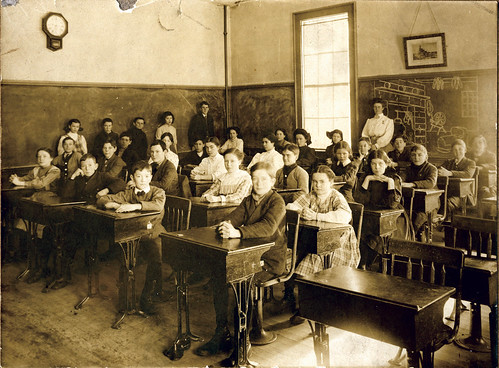
Why classrooms still look the same

Reading about the impact of change, both on the individual and institutional level highlighted, for me, the factors that cause change but also the impact of the change on society, particularly how society educates its citizens. What I have learnt is that although there are many changes within education, such as the adoption of many different Web 2.0 technologies or virtual technologies to connect learners, the technologies are merely being adopted within the already existing context (Siemens, 2008). For any long term changes to occur they would need to happen at a "system-wide level." This is one of the reasons why the modern classroom still looks very much like classrooms more than a century ago - there has been limited system-wide level change.

Today's classroom

Classroom by hpeguk, on Flickr
Creative Commons Creative Commons Attribution 2.0 Generic License   by  hpeguk 

Yesteryear's classroom

classroom by crackdog, on Flickr
Creative Commons Creative Commons Attribution 2.0 Generic License   by  crackdog 

What causes this limited change? David, in his reflection on what perpetuates "existing institutional systems and processes," highlighted a presentation by Dave Snowden where he identifies the "memories of the past" as one of the major contributors to making things stay the same. When any type of systemic change begins to happen, as outlined by Siemens (2008), a dance of change happens in the process. For example, if something different is implemented, such as an innovative approach to learning (i.e. networked learning) there will be significant resistance (known as push-back factors) to the change (the catalyst), basically attempts to revert back to the way things were before (Siemens, 2008), and this can go back and throw for a long time. This is the reason why modern classrooms, despite all the technological advances, still remarkably resemble the early 19th century classroom, the "push-back" factors have been too great.

What I found most interesting is the idea that "our ability to learn, grow, and adapt to change pressures is directly related to the nature of our learning environments (Siemens, 2008). The mere structure of the classroom, with its associated behaviours and procedures, causes it to shape what is learnt, due to the "primacy of the educator," and to create passive learners, who are "receptive agents." As a "bounded space" the classroom framework confines learning to particular contexts, particularly to the "ecology" of the classroom. What is needed, as asserted by Siemens (2008), and I agree, is learning how to create and navigate through networks, as I am currently doing as a student, learner and teacher in NGL and in my role as a learning coach. This is a connectivist framework that prepares learners on how to navigate through the "distributed nature of knowledge and growing complexification of all aspects of society (Siemens, 2008)."

What intrigues me is how the system-wide thinking influences entrepreneurs or individuals who are operating outside of these systems. I agree that the existing classroom model is archaic and a problem for many learners. I have many students who come to me because of their disengagement or frustration with the activities or processes of the classroom, and this is at both the high school and university level. This is why I am seeing the importance of having learning coaches or advisers who accompany the learner on their learning journey, as guides, modelling skills along the way and providing encouragement too. As Seimens (2008) posits the question: "Do one-instructor classrooms need to give way to more diverse approaches of many instructors and many peer learners?" I think so.

Siemens (2008) proposes a "future model of learning that must embrace" in addition to formal education:
... learning [to] occur through games and simulations, mentoring and apprenticing, performance support at the point of a learning need, self-learning that arises through critical and creative thinking, communities of practice and personal learning networks, as well as the many informal learning situations that arise through conferences, reading, volunteering, and hobbies.
As an educator I have learnt the truth of the notion by (Cannatella, 2007, p. 263 as cited in Siemens, 2008) that "[a]s we create space and place, we create ourselves." I have noticed this even in my studio, as a different environment can change not only how an individual perceives learning but also the opportunities that are available.

References:
Siemens, G. (2008). New structures and spaces of learning: The systemic impact of connective knowledge, connectivism, and networked learning. Retrieved from http://elearnspace.org/Articles/systemic_impact.htm

What will educators look like?

For several years I have been thinking a lot about "alternative education providers." After working in the public schooling system and listening to teachers and students talk about what they liked and didn't like so much I would often find myself daydreaming about the "what if?"

A paper by Siemens (2008) where he highlights the challenges to traditional education has been stimulating to say the least. I've already covered in a previous post some of his ideas regarding how the system of education is changing slowly with more of the same and how the proliferation of content on the web has caused what is dubbed "knowledge fluidity." I expressed my concern after the latter not because of the opportunities it provides budding education entrepreneurs but because of the "instability" and "flux" of "knowledge produced by the individual" (Pachler, 2007 as cited in Siemens, 2008). I have a feeling that my concerns are based on my prejudice of what constitutes knowledge and my conception of knowledge being produced by individuals or groups with authority. I also have a feeling, like Anne has expressed, that my ideas on this are changing.

Siemens (2008) talks about the importance of individuals developing "different mindsets." In an era of "supercomplexity" (Barnett, 2004 as cited in Siemens, 2008) he says, we need to transition from an epistemological (knowing things) to an ontological (becoming something) emphasis. These two superconcepts, as I've dubbed them, are two theories for conceptualising what is happening. To be able to navigate the sea of information we must go from "being in possession of a particular type of knowledge" to actually developing into a type of person who is able to continually learn and become something they were not before.

Anne recently shared a video "Teaching in the 21st Century" and it illustrates exactly what Siemens is talking about and everything that we are doing in NGL, both as learners and teachers. It highlights how teachers, or educators in general, need to move from being knowledge providers to skill providers. This particularly if we want to avoid becoming "obsolete" in a world where learners can access all the information in the world. The role of educators now is to model how to navigate through the "virtually limitless knowledge" - we need to act as "filters." Modelling how to handle having so much access to information but also be "relevant, challenging and engaging." It is one thing to send students to Google to search but as anyone who has tried to find valid and reliable sources has experienced, how does one know how to "validate, synthesise, leverage, communicate, collaborate and problem solve," as highlighted in the video. This is indeed a skill set that needs to be explicitly modelled, particularly how to create knowledge on the web, such as through blogging, animating and programming.

I think everyone will agree that education is changing and that there needs to be alternatives, particularly if we're going to have a system that nurtures innovation and creativity. Although it is impossible to predict accurately how education will look like in the future it is undoubtable that students will need to acquire the skills to be active participants, particularly, as my son has pronounced, they "need to get good at shovelling through the %$#@ to find the gems."

Gems by fdecomite, on Flickr
Creative Commons Creative Commons Attribution 2.0 Generic License   by  fdecomite 

References:
Siemens, G. (2008). New structures and spaces of learning: The systemic impact of connective knowledge, connectivism, and networked learning. Retrieved from http://elearnspace.org/Articles/systemic_impact.htm